
Decision Autopsy: The Commitment Ratchet
"Just one more." You have said this five times about the same failing decision. Each time felt like the solution. Cumulatively, it became the trap.

This is a Decision Autopsy: an examination of a real financial decision to understand how judgment actually forms, and where it breaks down. It’s about understanding process and recognizing patterns. Because better decisions start with better understanding of the ones that felt reasonable at the time.
This post introduces the series’ aim and value. You can find the entire Decision Autopsy series in this hub.
New Decision Autopsy posts are published every two weeks (alternating with the Uncomfortable Question series). A future post will map all of them.
For our general positioning and philosophy alignment see From Advice to Judgement and How to Stop Chasing Financial Advice and Start Making Better Money Decisions.
You can listen 🎧 to this article in the Substack app. Play button▶️ is at the top.

If you’re new here, welcome! Here’s where to start on what we covered so far:
FAQ and Questions for your considerations are at the end.
“Just one more.”
You have said this five times about the same failing decision.
Each time, it felt like the solution. Cumulatively, it became the trap.
And somewhere between the first time and the fifth, you stopped solving a problem and started protecting yourself from admitting the problem could not be solved this way.
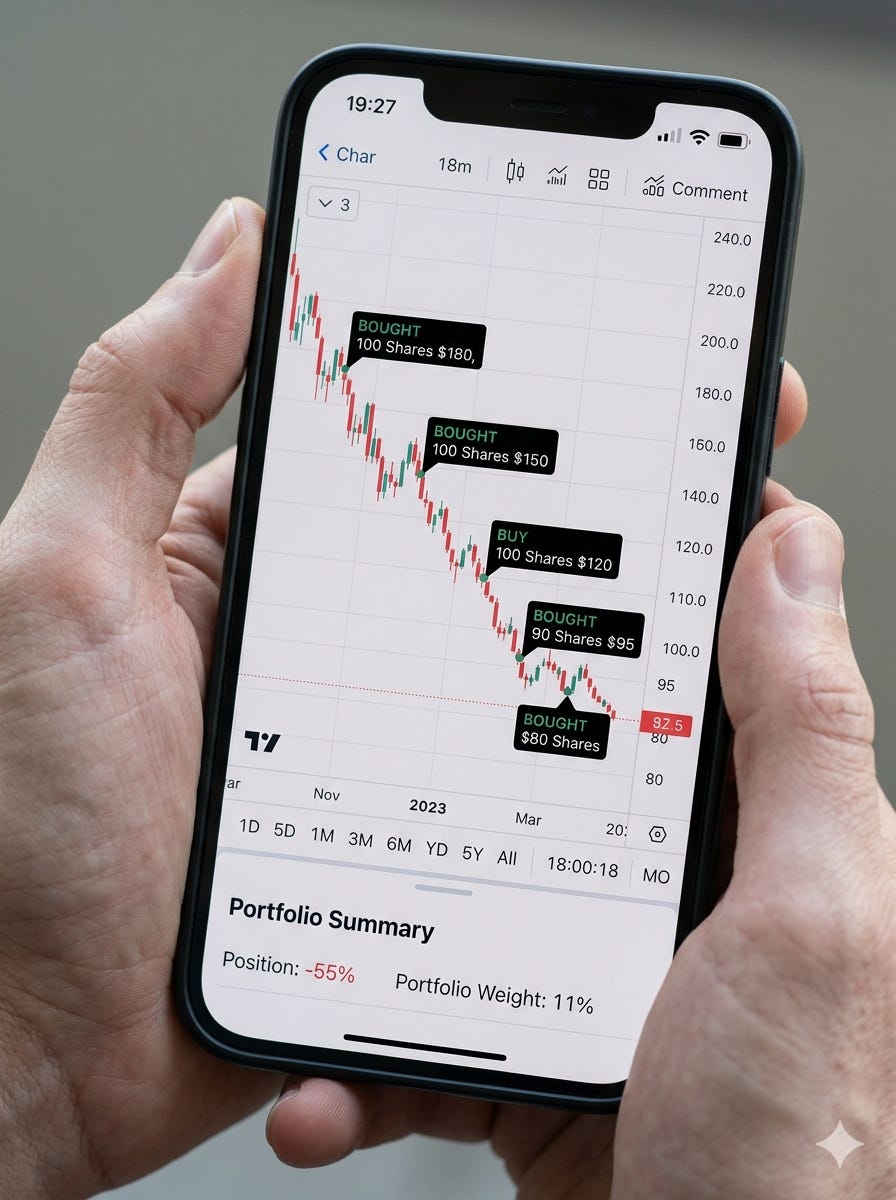
The stock was a sound purchase at $180. Quality company, defensible thesis, 5% of the portfolio. It dropped to $150.
“Just average down.” The fundamentals had not changed. He bought more. Position now 7%, average cost $165. Rational. It continued to $120.
“Just sell covered calls while I wait.” Generated $800 in premium. Disciplined response to volatility. The stock hit $115. The calls were likely to expire worthless.
“Just buy back the calls and roll them out.” Paid $600 to maintain control. Still defensible. Earnings weak. Stock dropped to $80.
“Just hold until it gets back to $100.” He set an exit price. He had a plan.
None of these decisions, in isolation, was irrational.
But here is what he cannot do now: exit.
The position is down fifty-five percent from initial cost. He is in a sold call position expiring in three months. The concentration grew to 11%; larger than intended, large enough that exiting triggers tax implications and portfolio disruption he is unprepared to manage.
Each “just one more” - averaging down, selling calls, rolling calls, holding through earnings, setting a mental anchor - was individually rational; an attempt to solve a problem.
Cumulatively, they created a position he cannot exit without accepting consequences larger than any single decision represented.
This is not sunk cost thinking. Sunk cost is past money holding you hostage. This is incremental future commitments that each felt like problem-solving but accumulated into structural lock-in.
Original $9,000 position is now $14,000 invested, worth $7,700. If he had exited after the first decline and redeployed to an index fund: $12,600. Instead: $14,000 committed, $7,700 in value, locked in options obligations, overconcentrated.
Each “just one more” made the next one easier and exit harder.
That is the ratchet. It clicks one direction. Each click feels like progress. And you do not realize you cannot reverse until you try.
The consulting business started with promise. Six months in, revenue was soft but the model seemed sound.
Month seven: “Just hire a marketing consultant for three months.” $5,000. Rational investment in growth. Revenue improved marginally.
Month eleven: “Just invest in a professional website.” $12,000. The business needed credibility. Conversions improved slightly.
Month fifteen: “Just try paid advertising.” $2,500 per month. Every business needs marketing spend. Some leads came in. ROI marginal but not negative.
Month eighteen: “Just hire a sales consultant to optimize conversions.” $8,000. Close rate improved from 18% to 21%.
Month twenty-one: “Just commit to a full year of content marketing. Consistency builds momentum.” Signed twelve-month contract at $3,500 monthly.
What she cannot do now: stop.
Total committed: $82,000 across five interventions. Current revenue: $6,200 monthly. Monthly burn: $3,500 in marketing commitments plus operating costs. She cannot stop the ads; she is in a contract. She cannot write off the website investment. She cannot unwind the infrastructure built to support revenue she has not reached.
Each commitment was meant to fix the revenue problem. Now she is trapped in a structure that requires continued revenue just to service the commitments made to generate that revenue.
If she had recognized after the marketing consultant that the model needed fundamental rethinking, she could have exited with a $5,000 lesson. Instead: $82,000 committed, twenty-one months invested, monthly obligations that make stopping more expensive than continuing.
She is not solving the original problem anymore. She is solving for the insufficiency of the previous solutions.
That is the second stage of the ratchet. You stop solving the problem and start solving for the fact that your previous solution did not work.
Do you know that feeling? When you realize you have been trying to fix the same thing for months or years and each fix just makes you more committed to proving the original decision was not a mistake?

The student loans totaled $85,000 at graduation. Standard ten-year plan: $550 monthly at 6.8 percent interest.
Year one: “Just refinance to twenty years.” Payment dropped to $375. Immediate relief. Total interest higher, but monthly cash flow worked.
Year three: “Just extend to twenty-five years.” Payment dropped to $310. Car purchase became possible. Strategic cash flow management.
Year six: “Just switch to income-driven repayment.” Payment dropped to $180. Mortgage qualification improved. But interest now accrued faster than payments. By year nine, balance grew to $96,000, higher than the original $85,000.
Year nine: “Just refinance again at a lower rate.” Locked in 4.5 percent, twenty-five-year term restart. Payment stayed manageable.
Year twelve: Balance is $103,000. Twenty-two years of payments remain. Total projected: $198,000.
If he had stayed on the original ten-year plan, the loan would be paid off now. Total paid: $104,000. Done.
Instead: each “just extend the term” click bought short-term payment relief at the cost of long-term obligation. Each one was defensible; cash flow was tight, other priorities pressed.
Cumulatively, they turned a $104,000 obligation into a $198,000 obligation spanning thirty-four years.
He cannot accelerate payments now without cutting a lifestyle that expanded into the freed-up cash flow.
The ratchet does not click once. It clicks incrementally. And each click feels like progress until you realize you cannot reverse direction anymore.

This is how the ratchet works.
The first “just one more” is genuinely a solution attempt. Average down on a quality stock. Hire a consultant for a revenue-soft business. Extend loan terms for cash flow relief. Each decision is defensible, targeted, rational.
But each subsequent “just one more” is no longer solving the original problem. You are solving for the insufficiency of the previous solution. Selling covered calls because averaging down did not work. Hiring a sales consultant because the marketing consultant did not generate enough. Refinancing again because the previous extension did not provide enough relief.
The commitments become structurally interdependent. You cannot unwind one without triggering cascade effects on the others.
The stock position cannot be exited without realizing losses and unwinding options and rebalancing the portfolio. The business cannot stop marketing spend without admitting the infrastructure was premature. The loan cannot be accelerated without cutting the lifestyle the payment reductions made possible.
You are no longer making commitments to optimize outcomes. You are making commitments to protect previous commitments.
That is the diagnostic. That is when the ratchet has you.
The cost is not the individual commitments. Those were each defensible.
The cost is the accumulation.
Stock investor: $14,000 invested, $7,700 current value, opportunity cost of $4,900 against index fund deployment.
Business owner: $82,000 committed to fix a model that needed rethinking, not additional marketing.
Borrower: $94,000 in additional interest and twenty-four additional years of payments.
None of these people made one catastrophically bad decision. They made a dozen small, defensible commitments that locked together into a structure they cannot exit.
The ratchet does not announce itself. There is no moment where it says “this is the commitment that makes reversal impossible.” Each click feels like the one that will finally solve it.
But ratchets only go one direction.
You average down, so you sell calls. You sell calls, so you cannot exit before expiration. You cannot exit, so you hold through events you would have avoided. You hold through events, so you set mental anchors. Each commitment creates the conditions that make the next commitment necessary.
You hire a consultant, so you build a website. You build a website, so you buy ads. You buy ads, so you hire a sales consultant. You optimize conversions, so you commit to content marketing. Each spend creates infrastructure that demands the next spend to justify it.
You extend the loan term, so you qualify for the car. You qualify for the car, so you extend again for the house. You extend again, so the balance grows. The balance grows, so you refinance. Each extension creates obligations that make the next extension necessary.
This is not sunk cost. Sunk cost is “I have already spent $50,000, I cannot quit now.” That is past money holding you hostage.
This is “I have committed $50,000 across ten incremental decisions, and unwinding any single commitment triggers consequences across the entire structure.” That is structural lock-in emerging from individually rational acts.
The ratchet is more expensive than sunk cost because it does not feel like a trap. It feels like problem-solving. Each click feels active, strategic, responsive. You are not paralyzed. You are not in denial. You are making decisions.
You just cannot make the decision to stop.
Because stopping now costs more than any individual commitment did. And continuing costs more than stopping would have cost at any previous stage.
The trap is not the individual decisions. The trap is the accumulation.
And by the time you see it, the ratchet has already tightened past the point where reversal is possible without pain greater than any single commitment cost.
That is not a failure of judgment. That is the mechanism.
The ratchet clicks when you say “just one more” to the same problem for the fifth time.
It tightens when you realize you are making new commitments to protect old ones rather than to solve the original problem.
It locks when you discover that exit requires accepting losses larger than any single decision represented but smaller than the cumulative cost of staying.
You do not see it forming because each click, individually, was rational.
And once you see it, you cannot unsee it.
Not in your stock position, not in your business, nor in your debt structure.
Not in the commitment you are about to make that sounds, even now, like “just one more.”

This is what we call a Decision Autopsy. We’ll be doing more of these. You can find all previous Decision Autopsies here.
Missed the big one? Wealth GPS was recently featured in the 10 Under-discovered Substack Financial Writers You Should be Reading, January, February and March 2026 Monthly Digest - a curated collection of the best writing on personal finance on Substack. Read it here to discover other fantastic finance writers.
Questions for Your Consideration
1. Count your clicks
Think about your largest financial position: the investment, the business, the debt obligation. How many times have you said “just one more” about it?
“Just average down.”
“Just extend the term.”
“Just hire one consultant.”
“Just hold through this quarter.”
If you’ve said some version of “just one more” three or more times about the same decision, then you’re in a ratchet. Each intervention made the next one necessary. And the next one will too.
2. What are you solving for?
Ask yourself: are you solving the original problem, or are you solving for the fact that your previous solution didn’t work?
If your marketing consultant didn’t generate enough leads, hiring a sales consultant isn’t solving the lead generation problem; it’s solving for the insufficiency of the marketing consultant.
If averaging down didn’t work, selling covered calls isn’t solving the investment thesis; it’s solving for the fact that averaging down didn’t work.
When your interventions start solving for previous interventions, you’re not problem-solving anymore. You’re ratcheting.
3. The exit test
Try this thought experiment: If you could exit your current position/business/commitment with zero consequences - no loss, no judgment, no obligations - would you?
If the answer is “yes, immediately” but you’re not exiting because of the accumulated commitments (options obligations, business infrastructure, extended debt terms, interconnected positions) then you’re locked in by the ratchet, not by the original decision.
4. Calculate the cumulative cost
Add up all your “just one more” interventions. Not the original decision; just the fixes.
Every averaged-down purchase. Every consultant hired. Every term extension. Every additional commitment made to salvage the previous one.
If that cumulative cost exceeds what walking away would have cost after the first intervention failed, then the ratchet has cost you more than the original decision ever did.
FAQ
Q1: How is the commitment ratchet different from sunk cost fallacy?
A1: Sunk cost fallacy is about past money holding you hostage: “I’ve already invested $50,000, I can’t quit now.” The commitment ratchet is about incremental future commitments: “Just invest one more $5,000 and this will turn around,”said five times. Sunk cost is one large past investment preventing exit. The ratchet is many small future commitments that accumulate until exit becomes structurally impossible. The cost isn’t what you’ve already spent; it’s the web of ongoing obligations each “just one more” created.
Q2: What is escalation of commitment, and how does it relate to the ratchet?
A2: Escalation of commitment is the commitment ratchet’s psychological driver. It’s when we throw good money after bad not to solve the problem, but to prove we weren’t wrong in the first place. Sunk cost says “I’ve invested too much to quit.” Escalation says “I must keep investing to prove the original decision was right.” The ratchet is the mechanism (each commitment makes the next one necessary). Escalation is the emotional fuel (ego protection, admission avoidance). Together, they explain why the stock investor keeps averaging down even after the thesis breaks, why the business owner keeps hiring consultants even after the model proves flawed. Each intervention is partly about solving the problem and partly about proving the original decision wasn’t a mistake. That emotional component - proving you weren’t wrong - makes each click of the ratchet feel even more necessary.
Q3: Can’t “just one more” sometimes be the right move? How do I know when it’s problem-solving vs. ratcheting?
A3: Yes, sometimes “just one more” genuinely solves it. The distinction is what you’re solving for. If you’re solving the original problem (revenue is soft, so I’ll adjust the business model), that’s problem-solving. If you’re solving for the insufficiency of the previous solution (the marketing consultant didn’t work, so I’ll hire a sales consultant), that’s ratcheting. Ask: would I make this same commitment if I were starting fresh today, or am I making it because I’ve already made the previous four? If it’s the latter: ratchet. If your interventions start requiring previous interventions to make sense: ratchet.
Q4: I recognize I’m in a ratchet. How do I get out?
A4: This is a diagnostic series, not prescriptive; the goal is recognition, not solution. But the diagnostic itself often reveals the path: you’re locked in by the cumulative commitments, not by any single one. Calculate what unwinding costs versus what staying costs over the next 12-24 months. Often, the pain of exit (realized losses, unwinding obligations) is less than the cumulative cost of another year of ratcheting. The ratchet convinces you that “just one more” will finally solve it. It won’t. Once you’re in stage three (structural lock-in), the next intervention just deepens the trap. Recognition is the first step toward stopping the clicks.
Q5: Are some financial decisions more susceptible to ratcheting than others?
A5: Yes. Any decision with: (1) ongoing obligations that can be incrementally adjusted (debt terms, portfolio positions, business spending), (2) measurable performance that can deteriorate gradually (stock prices, revenue, cash flow), and (3) multiple intervention points (averaging down, extending terms, hiring consultants) is ratchet-prone. Stock positions, business operations, and debt structures are particularly vulnerable. One-time purchases with no ongoing modification options (buying a car, closing on a house) have less ratchet risk; you can’t average down on a car or extend a house purchase. The ratchet requires the ability to make “just one more” commitments to the same decision.
Q6: What if my “just one more” interventions are working? Can a ratchet be positive?
A6: If each intervention is genuinely solving the problem and you’re exiting successfully after achieving the goal: that’s not a ratchet, that’s iterative problem-solving. The ratchet only forms when interventions create structural lock-in without solving the underlying problem. The test: are you closer to exit or farther from it after each intervention? Closer = problem-solving. Farther (more concentrated, more obligated, more interdependent) = ratchet. A ratchet’s defining feature is that each click makes reversal harder while creating conditions that demand the next click.
Thank you for joining us,
Elizabeth
Wealth GPS
Disclaimer: The content in this publication is for informational and entertainment purposes only. It reflects the personal opinions of the author and should not be considered financial advice, recommendations, or a solicitation to buy or sell any financial products. Posts are written for a general audience and do not consider your specific financial situation. The author is a former financial planner and does not offer financial planning or advisory services through this publication.
Substack thrives on thoughtful conversation and sharing; feel free to re-stack this post, share it with others, or write your own Notes in response. You’re also welcome to download and use any free tools or resources provided; they were created you in mind and they are yours to keep. If you’d like to repost or quote from this article elsewhere, please credit the source and link back. For anything beyond brief excerpts, just reach out for permission.
That stock purchase example and “just average down” brings back a horrible memory. Taught me a lesson though. Another thought provoking article, thank you.
The commitment ratchet is real. But it isn’t primarily a behavioural failure.
It’s a structural one.
The problem isn’t that people make a series of bad decisions. It’s that each decision isn’t contained, so it spills into the next.
Commitments accumulate.
Exit costs rise.
At some point, you’re no longer choosing. You’re maintaining. Behaviour gets blamed but structure is the cause.